If you have ever spent an afternoon with a toddler, you know that their world moves at an astonishing speed. One minute they are stacking plastic blocks, the next they are racing toward the kitchen, and a second later, they are completely captivated by a passing beetle outside the window. To an adult, it looks like beautiful, unpredictable chaos. To a child, it is simply a very busy day.
Capturing this rapid, rhythmic energy of early childhood is exactly what former Children’s Laureate Michael Rosen does best. Known globally for his classic We’re Going on a Bear Hunt, Rosen has an unmatched ability to write stories that mirror the natural way young children speak, move, and think.
Among his collections for infants and toddlers, “Busy Day” stands out as a brilliant piece of rhythmic interactive storytelling. Whether you are a parent in the United States looking to diversify your bedtime reading, or an early educator in India building a foundational language framework, this book is a vital tool for early childhood development.
1. What is “Busy Day” by Michael Rosen About?
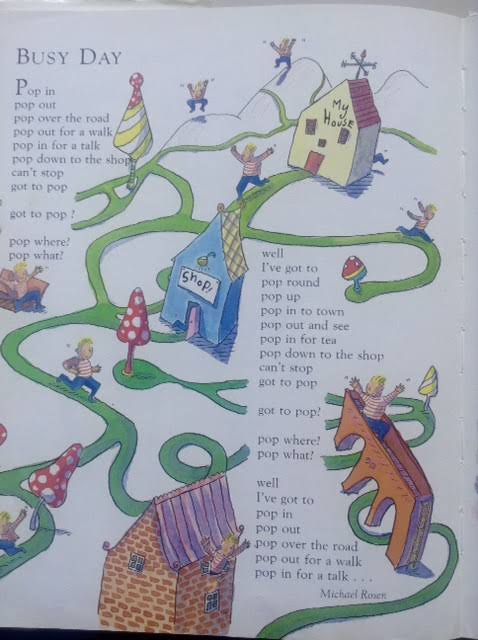
At its core, Busy Day is an interactive lift-the-flap book designed for infants, toddlers, and preschoolers. Illustrated beautifully by Selina Young, the book follows a young child and their father as they navigate the simple, comforting routines of a standard day.
The story guides readers through a series of familiar, action-oriented childhood milestones:
-
Splashing in the bath water.
-
Feeding hungry birds in the garden.
-
Dressing up in oversized clothes.
-
Cleaning up a cluttered room after playtime.
Instead of relying on a dense, complicated narrative plot, Rosen uses ultra-simple, repetitive action words (verbs) like “pop in”, “pop out”, and “bounce”. Each page presents a small action puzzle, prompting the child to lift a sturdy paper flap to discover what happens next. The simplicity is the stroke of genius; it transforms passive listening into an active, physical game.
2. Why Young Children Connect with Rhythmic Language
Have you ever wondered why children can listen to the exact same short story fifty times in a row without getting bored, while adults lose their patience by reading number three? It comes down to how a child’s brain processes early language patterns.
The Power of Phonetics and Repetition
Michael Rosen builds his books using a technique called phonetic repetition and onomatopoeia (words that imitate real-world sounds). When you read Busy Day, the text flows with a natural cadence that feels like a song.
This rhythmic bounce isn’t just entertaining; it acts as a structural scaffold for language acquisition. When a child hears the rhythm repeated, they learn to predict the next word. Prediction breeds confidence, and that confidence encourages toddlers to start shouting out the words along with you, accelerating their verbal development.
3. The Developmental Benefits of Lift-the-Flap Books
For a toddler, Busy Day is more than a book—it is a physical toy. Lift-the-flap books provide critical cognitive and motor milestones that traditional flat-page books cannot match.
Key Learning Milestones Triggered:
-
Fine Motor Skills: Pinching, grasping, and carefully lifting a paper flap helps strengthen the small muscles in a child’s fingers and hands. This dexterity forms the physiological foundation for learning to hold a pencil and write later on.
-
Understanding Object Permanence: For an infant under one year old, if they cannot see an object, they think it has completely ceased to exist. Lifting a flap to reveal a hidden bird or a toy teaches them object permanence—the cognitive understanding that things remain hidden right beneath the surface.
-
Hand-Eye Coordination: Synchronizing the act of listening to a spoken cue (“Where is the puppy?”) with the physical movement of lifting the correct flap builds strong neural connections between visual tracking and physical action.
4. Actionable Tips for Parents and Educators
To unlock the full educational value of Busy Day by Michael Rosen, you should avoid reading it in a flat, monotone voice. Use these practical, real-world reading strategies to turn storytime into an engaging learning session:
-
Embrace Performance Reading: Change your vocal pitch. Use a booming voice for large actions and a tiny whisper when the character is hiding. Lean heavily into the rhythm of the text, rocking slightly back and forth to emphasize the beat.
-
Connect the Book to Real Life: Use the story as a bridge to daily routines. When your child is taking a real bath, echo the lines from the book: “Just like in our Busy Day book, look at you splash!” This reinforces word comprehension by linking the abstract page to their physical world.
-
Pause and Let Them Fill the Blank: Once your child becomes familiar with the rhythm, stop right before a major action word or before lifting the flap. Look at them expectantly and let them fill in the missing word.
-
Follow Up with a Physical Game: After closing the book, turn your living room into a real-life version of the story. Play a quick game of “Simon Says” using the exact same action verbs used by Rosen—instructing your child to pop up, sit down, or spin around.
5. How This Book Bridges Indian and American Early Classrooms
Though written by a British author, the universal appeal of Busy Day makes it a brilliant cross-cultural bridge for early classrooms in both the United States and India.

In the USA, where early childhood curricula place a massive premium on dialogic reading (interactive conversations built around books), Busy Day serves as an ideal framework for preschool literacy screens. It encourages the child to talk back to the page rather than just staring blankly.
In India, where bilingualism is the standard reality for most households, the ultra-simple sentence structures make it an ideal tool for English Language Learners (ELL). Because the action words are tied directly to an immediate visual illustration hiding under a flap, young children can easily map the new English vocabulary words directly onto actions they already understand in their native languages, whether it is Hindi, Bengali, or Tamil.
Frequently Asked Questions (FAQs)
Q1. What is the ideal age group for Michael Rosen’s “Busy Day”?
The book is primarily engineered for children aged 6 months to 3 years old. Infants enjoy the high-contrast illustrations and the physical movement of the flaps, while toddlers and preschoolers engage directly with the rhythmic language and action vocabulary.
Q2. How does “Busy Day” compare to “We’re Going on a Bear Hunt”?
While We’re Going on a Bear Hunt is a grand, continuous adventure story meant for preschoolers and older children, Busy Day is broken up into shorter, self-contained daily routines, making it much more digestible for shorter infant attention spans.
Q3. Are the flaps durable enough to withstand rough toddler play?
Most editions of Busy Day are published as sturdy board books featuring thick, heavy-duty cardboard flaps designed specifically to survive being pulled, yanked, and bent by eager toddlers.
Q4. Why is Michael Rosen so highly recommended for early childhood literacy?
Michael Rosen’s mastery lies in his background in linguistics and performance. He writes specifically for the spoken voice. His books rely on natural speech cadences, making them exceptionally easy for developing brains to decode, mimic, and remember.
Conclusion: A Must-Have Addition to Your Child’s Bookshelf
In an increasingly digital world full of flashing tablet screens and hyper-stimulating kids’ videos, Busy Day by Michael Rosen proves that you don’t need algorithms to captivate a child’s imagination. A simple, beautifully cadenced rhyme combined with a cardboard flap is all it takes to trigger profound cognitive growth, language development, and joy.
By turning reading from a passive chore into an active, physical game, this book helps foster a lifelong love for literature right from infancy. If you want to expand your child’s vocabulary, improve their motor skills, and share a few laughs during bedtime, adding this classic to your home or classroom library is a brilliant step forward.