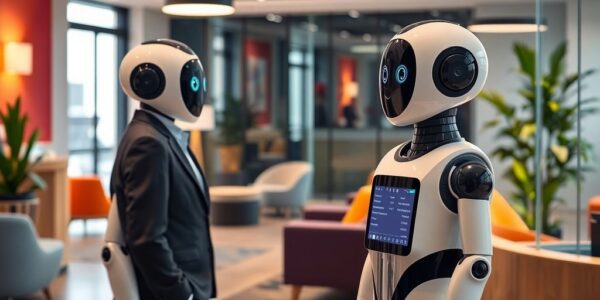
Introduction: Why the Receptionist Role Is Under Pressure in 2026
In the service-based companies, the issue of human vs AI receptionists is no longer speculative; it is a real-world case. The receptionist becomes the initial, and even sole, interaction point of a customer with a brand. Even one missed call may translate to a lost patient, a lost legal consultation or lost booking to a competitor.
With the shift in the virtual receptionist as a revenue-focused, rather than optional, factor as appointment-driven businesses evaluate AI receptionist cost comparison, virtual receptionist efficiency, and effect of automated appointment scheduling is experienced, availability and responsiveness becomes an essential aspect of the operation of the virtual receptionist.
However, today business is under an increasing dilemma.
Human receptionists are costly, not very scalable and limited by the working hours. Meanwhile, the expectations of customers have changed drastically. It is time that clients are demanding quick response, after-hours services and smooth scheduling, whether it is a call to a dental clinic at 9 p.m. or a messaging service in a salon on Sunday morning.
This compulsion has intensified the quest to adopt AI-powered virtual receptionists, whereby the business owners have taken receptionist models seriously concerning three key areas namely cost, speed, and efficiency.
As an expert in technology and operations initiatives in service industries, I witnessed similar inflection points in the past, more than 25 years ago, email taking the place of fax, CRMs taking the place of paper files, cloud taking the place of on-premise servers. The same has been happening to the receptionist job.
This article is a well-balanced and clear-cut comparison of the best that gives a decision-maker a clear picture of what works best in their business nowadays- and what will scale tomorrow.
1. AI Receptionists Cost Comparison: The True Price of Human vs AI Receptionists
On paper, hiring a receptionist seems straightforward: a salary and perhaps a few benefits. In practice, the total cost is far more complex. By analyzing receptionist automation ROI, businesses can quantify cost savings, time efficiency, and scalability benefits before fully committing to an AI solution.
Human Receptionist Costs
- Annual salary: $35,000–$50,000
- Benefits & payroll taxes: +20–30%
- Training & onboarding time
- High turnover replacement costs
- Limited coverage (business hours only)
- Overtime for evenings, weekends, holidays
AI Receptionist Costs
- Monthly subscription or licensing fee
- One-time setup and system integration
- Minimal ongoing maintenance
- No sick days, breaks, or vacations
- Unlimited availability (24/7/365)
Side-by-Side Cost Comparison
| Cost Factor | Human Receptionist | AI Receptionist |
| Annual Cost | $45k–$65k+ | $3k–$12k |
| Coverage | Limited hours | 24/7 |
| Scalability | Linear (hire more staff) | Instant |
| Break-even Point | N/A | 2–4 months |
2. Speed Comparison: Why Response Time Drives Revenue
Speed is one of the most important distinguishing factors between human and AI receptionists, particularly in the case of businesses that rely on appointments where time wastage can be directly related to lost profits.
Human Receptionist Speed Limitations:
- Accepts and makes one call at a time (single-threaded).
- Mean waiting time: 3090 seconds during peak times.
- Booking time: 3-7 minutes on an appointment basis.
- During peak times, call queues go up.
- After hours, weekends, and holidays are characterized by missed calls.
- Fatigue, workload, and staffing gap performance.
AI – Powered Receptionist Benefits:
- Quick response time with no waiting.
- Answers and takes several calls and chats at the same time.
- Booking an appointment in seconds.
- Stable work when there are high numbers of calls.
- At any time, 24/7 and unfatigued.
- Test cancellations and rescheduling done immediately.
Real-World Scenarios
Healthcare:
A patient makes a call outside the office hours to make an urgent appointment. AI makes instant schedules, rather than voicemail routing.
Legal:
One of the potential clients makes a call on a weekend. AI takes the details of the case and schedules an appointment.
Beauty & Wellness:
Several clients will attempt to make a booking during the peak hours. In this case virtual receptionist efficiency is much better than the human receptionist.
In both instances, quicker response is a direct proportionality to conversion.
3. Efficiency Deep Dive: How Work Actually Gets Done
Accuracy and Consistency
Accuracy and consistency is a big challenge to human receptionists most especially when they have long shifts or when the receptionists are on peak. On the contrary, AI receptionists can provide consistent performance on a regular basis and minimize the error, increasing reliability. When evaluating traditional receptionist vs AI, businesses must consider not only cost and speed, but also accuracy, scalability, and the quality of human interaction.
Human performance varies based on:
- Burnout, long-shifts and fatigue.
- Dissimilarity in training and experience.
- Multitasking stress and distractions.
- Varying work load during peak hours.
AI systems operate with:
- Consistency based on rules throughout all interactions.
- Approved responses in standardized format.
- New learning and improvement in the long term.
Such consistency minimizes mistakes like bookings being made twice, follow ups being missed and the exchange of wrong information that mostly occur in high volume operations.
Appointment Management Excellence
Automated Appointment scheduling and management is important in ensuring maximum revenue and less frustration to the customer. AI receptionists facilitate the process of scheduling, reminders, and coordination of many providers, and perform the routine tasks more quickly than humans.
AI receptionists excel at:
- Accurate availability and scheduling.
- Disagreement prevention: calendar.
- Automated messages through calls, SMS or email.
- Reduction of no-show by confirmations in time.
- The coordination of multi-providers or multi-locations.
These features enable organizations to book more, minimise appointments, and enhance the overall efficiency of the operations without the need to employ more personnel.
Integration Capabilities
The ability to integrate with the existing tools seamlessly will make sure that AI receptionists become part of the existing workflow. The human receptionists usually depend on manual data entry and this adds errors and delays.
The next-generation AI receptionists are being incorporated with:
- CRM solutions of integrated information on customers.
- Real time available Google and Outlook calories.
- Deposit or prepayment payment systems.
- Software (healthcare, legal, real estate) Industry.
Integrations minimize mistakes, consolidate data, and enable companies to automate the working process on numerous platforms effectively.
Scalability: Linear vs Exponential
The human resource approach is both expensive and time-intensive because the more receptionists hired, the higher the overhead. AI receptionists on the other hand, do not require high volumes and thus do not incur high extraneous costs.
To scale human receptionists, it will require:
- Hiring additional staff
- Shifts and cover scheduling.
- Relative increases in the labor costs.
Making AI receptionists is possible, which makes it possible to:
- Dealing with 10 or 10,000 contacts at once.
- Little variation in the cost of operation.
This difference becomes critical during growth phases, have seasonal peaks, or are in high demand.
Data and Insights
Human receptionists are able to give feedback which is usually anecdotal and not consistent. AI receptionists create smart, real-time information that can be used to make smarter business decisions.
Human receptionists offer:
- Non-formal, informal feedback.
24/7 virtual receptionist offer:
- Inquiry volume analytics and call volume analytics.
- Conversion and booking rate.
- Peak demand and trend analysis.
- Real-time actionable insights.
The insights allow the businesses to keep on optimizing the scheduling, resource allocation and customer experience strategies.
4. Where Humans Still Win (And Always Will)
Despite AI’s strengths, there are areas where humans remain irreplaceable:
- Emotionally sensitive conversations
- Complex judgment calls
- Crisis management
- In-person greetings and physical tasks
- Relationship-building for high-touch services
AI is the best fit to handle repetitive, structured tasks in large numbers, and human beings offer empathy, intuition, and personal touch, which is the key to strong client relationships.
5. Industry-Specific Comparison
There is no universal AI receptionist, as its performance in selecting an industry and the complexity of human interaction will vary. This is the way AI and humans do not substitute one another in various service fields.
Healthcare
Timely communication and accuracy are vital in any healthcare, yet sensitivity to patients is often a human need.
AI handles:
- Monthly appointment scheduling.
- Auto confirmations and reminders.
- After-hours calls and non-urgent calls.
Humans handle:
- Urgent or emergency cases
- Confidential talks which call on sympathy and tact.
Best option: Hybrid – AI takes care of routine tasks, whereas human beings deal with important interactions with patients.
Legal Services
AIn legal practice, there is a need of confidentiality, delicate judgment, and the establishment of trust with the clients.I handles:
- Intake and qualification of clients.
- Arranging follow-ups and consultations.
Humans handle:
- Complex legal discussions
- Trust-building
Best model: Hybrid – AI simplifies the work of the administration, human beings are in control of the advisory work.
Beauty & Wellness
The custom service is the important thing in a salon or wellness center, however, regular appointments and notifications can be automated.
AI handles:
- Booking of appointments and upselling services.
- Notifications and validations.
Humans handle:
- Customer experience and relationship with clients.
- Personal counseling and instructions.
Best model: AI-first, human-support- AI does the volume, human-support does the personalization.
Real Estate
The speed of handling leads is essential in any property transactions yet it is done through human negotiation when it comes to closing deals.
AI handles:
- Qualification and follow-up of Leads.
- including and viewing, open house coordination.
Humans handle:
- Contract closing and negotiation.
- Individual dealing with the client.
Best model: AI-assisted agents – AI automates logistics, human beings handle high value interactions.
Professional Services
The multi-step processes such as client intake and compliance could be automated, whereas the advisory work needs expertise.
AI handles:
- Multi-stage client intake forms.
- Reminders and scheduling conscious of compliance.
Humans handle:
- Relationship management, advisory and consulting.
Best model: Hybrid – AI decreases administrative overhead, human beings combine expertise and guidance.
6. The Hybrid Approach: The Most Practical Path Forward
The most successful businesses are not choosing between humans and AI—they are combining both.
In a hybrid model:
- AI does repetitive tasks that are large.
- Exceptions and relationships are dealt with by human beings.
- Costs are optimized
- There is enhanced customer experience.
This shift may be a slow one, with initially after-hours automation or overflow management, then extending coverage.
7. Case Example: Reducing Interruptions with AI Automation
An example of a SaaS-based service company that automated the work of a receptionist through AgentZap.ai.
The system:
- Dispatched automatic customer and internal queries.
- Combined with Slack and ticketing applications.
- Utilized API-first to forward only completed and high-complexity issues to the engineers.
Results after three months:
- 70% reduction in staff interruptions
- 80% of tier-one inquiries resolved automatically
- Significant improvement in response times
- Lower burnout and higher focus
The key insight: AI didn’t replace people—it protected them from constant interruptions.
8. Making the Decision: A Practical Checklist
The decision on whether to use a human receptionist, AI system, or some combination of the two can only be made by understanding what your business needs, and what your customers expect. This could be done by answering a few important questions to reach the solution that will give the best efficiency, cost-effectiveness, and satisfaction to the customer.
- What is the number of calls or inquiries being missed? The high rates of missed-call can be an indicator of 24/7 or scalable AI-supporting.
- Are the customers round-the-clock demanding? In case it is yes, AI guarantees a quick reaction during off hours.
- How much does it cost to respond late? Take into account the lost revenues, appointments, and dissatisfaction of customers.
- What are the complexity of common questions? Mundane inquiries may be automated, whereas delicate or sensitive matters need to be handled by human beings.
- Where is your development curve? Scalable AI solutions can be necessary to process a large volume of data at a lower staffing cost due to rapid expansion.
Decision insight: Your responses will determine which type of human, AI, or hybrid model should be used in your operations. In many cases, a hybrid solution, i.e. where the AI copes with common tasks and human exception handling is most balanced in terms of efficiency, cost, and customer experience.
Conclusion: Evolution, Not Replacement
In conclusion, it is essential to note that evolution, rather than replacement, is necessary.
The human vs AI receptionist is not a debate on human replacement, but it can be on changing the business approach of dealing with the customers. AI receptionists are phenomenal at reducing expenses, high volumes, responding to and improving responses, and scaling easily, which is why they are invaluable with routine and repetitive work.
Instead, human receptionists still offer what AI is yet to offer, including empathy, subtle judgment, and good relationship-building, especially when involved in sensitive or complex interactions.
Combinations are the most successful businesses that are combined both intelligently. AI is a structured and high volume work whereas humans are critical as well as high touch in their interactions. This hybrid model is successfully implemented by such solutions as AgentZap.ai, which automated the process of routine inquiries but sent complex cases to human employees to establish the seamless efficiency and personal service balance.
The inquiry that service-based firms now pose is no longer whether AI will change the service of the receptionist, but how fast they evolve to have it work to their benefit. Through the strategic use of both AI and human skills, firms can ease the burden of operations, improve customer experience and remain competitive in the market.
About the Author:
Usman Rana is a technology leader with over 25 years of experience in enterprise systems, e-commerce innovation in emerging markets, and AI-driven solutions for business transformation.