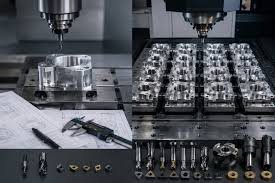
For many businesses, developing a new product starts with an idea, a drawing, or a functional prototype. However, turning that prototype into a stable mass-produced product is a much more complex process. Companies must consider material selection, design optimization, tolerance control, production cost, quality consistency, and delivery time. CNC machining plays an important role in this transition because it offers high precision, flexible production, and reliable repeatability.
Whether a company is producing machine parts, automotive components, electronic housings, medical device parts, or industrial equipment components, understanding how CNC machining supports both prototyping and mass production can help reduce risk and improve product success.
CNC Machining: What Is It?
CNC machining is a manufacturing technique that removes material from a solid workpiece using computer-controlled machinery.Milling, turning, drilling, tapping, boring, grinding, and multi-axis machining are typical CNC operations.Aluminium, carbon steel, stainless steel, brass, copper, plastics, and engineered materials are examples of materials.
Compared with manual machining, CNC machining offers better accuracy, repeatability, and efficiency. Once a program is created and tested, the same part can be produced repeatedly with consistent dimensions and surface quality.
This makes CNC machining useful not only for prototypes, but also for small-batch production, medium-volume orders, and mass production.
Why CNC Machining Is Useful for Prototypes
During the prototype stage, businesses often need to test whether a design works in real conditions. A prototype may need to check assembly fit, strength, appearance, function, or user experience. Because it can create parts from actual engineering materials rather than just samples, CNC machining is beneficial.
For example, an aluminum prototype can be tested for strength, heat resistance, surface finish, and assembly performance. A plastic prototype can be checked for size, shape, and product fit. This helps engineers identify design problems before investing in molds, tooling, or large-scale production.
CNC machining also supports fast design changes. If a hole position, wall thickness, slot, thread, or surface feature needs adjustment, the CNC program can be modified without building a completely new tool.
Moving from Prototype to Production
A successful prototype does not automatically mean the product is ready for mass production. Before scaling up, businesses should review the design from a manufacturing perspective. Design for manufacturability, or DFM, is a common term for this procedure.DFM assists in determining whether the part can be produced successfully, reliably, and economically..
DFM helps identify whether the part can be produced efficiently, consistently, and cost-effectively. Some prototype features may be easy to make in one sample but difficult or expensive in large quantities. Sharp internal corners, deep cavities, thin walls, tight tolerances, and complex surfaces can all increase production cost.
By working with an experienced CNC machining service, businesses can optimize the design before mass production begins. This may include simplifying unnecessary features, adjusting tolerances, selecting better materials, or improving fixture design.
Material Selection Matters
Material choice affects product strength, weight, cost, machining difficulty, surface treatment, and long-term performance. During the prototype stage, companies may test several materials before choosing the final option.
Because it is lightweight, machine-friendly, and anodizable, aluminium is utilised extensively. Stainless steel offers strength and corrosion resistance but is harder to machine. Brass and copper provide good electrical or thermal conductivity. Engineering plastics may be selected for insulation, light weight, or chemical resistance.
For mass production, the selected material should be stable, available, and suitable for the product’s working environment. Material availability also affects lead time and cost, especially for large orders.
Tolerance and Quality Assurance
One of the most crucial aspects of CNC machining is tolerance management. A prototype may work well as a single part, but mass production requires every part to meet the same standard. If dimensions vary too much, parts may not assemble properly, perform correctly, or meet customer expectations.
Businesses should clearly define which dimensions require tight tolerances and which dimensions can use standard tolerances. Applying tight tolerances everywhere may increase machining time, inspection cost, and scrap rate.
Quality control methods may include dimensional inspection, surface roughness testing, material verification, thread checks, and first article inspection. Stable inspection processes assist guarantee that every batch satisfies the necessary requirements for mass manufacturing.
Cost Factors in CNC Machining
CNC machining cost depends on several factors, including material type, part size, machining time, tolerance requirements, surface finish, order quantity, and complexity. A part with many setups, deep holes, thin walls, or complex 3D surfaces usually costs more.
Production volume also matters. Prototype parts often have a higher unit cost because setup time is spread across only a few pieces. In mass production, unit cost can decrease because programming, fixture preparation, and setup costs are shared across larger quantities.
Businesses should evaluate both prototype cost and long-term production cost. A low-cost prototype design may not always be the best choice for mass production if it requires slow machining or difficult inspection.
Surface Finishing Options
Many CNC machined parts require surface finishing after machining. Common options include anodizing, powder coating, plating, polishing, brushing, sandblasting, passivation, and black oxide treatment. Surface finishing can enhance a product’s appearance, wear resistance, corrosion resistance, or branding.
The finishing method should be considered early in the design process because it may affect dimensions, tolerances, and material selection. For example, anodizing adds a thin surface layer, while plating may change part thickness slightly.
Choosing the Right CNC Machining Partner
The right manufacturing partner can make the transition from prototype to mass production much smoother. A good supplier should provide technical communication, material advice, process planning, quality inspection, and stable delivery support.
Anhua Machining can help companies with CNC machining solutions for larger production requirements, small-batch production, and prototype development. For growing companies, working with a supplier that understands both engineering requirements and production efficiency can help reduce delays and improve product quality.
Conclusion
CNC machining is a practical and reliable manufacturing method for businesses moving from prototype to mass production. It allows companies to test real materials, improve product design, control dimensions, and produce consistent parts at different production volumes.
Before scaling up, businesses should review design manufacturability, material choice, tolerance requirements, surface finishing, quality control, and total production cost. With careful planning and the right machining partner, companies can reduce production risks and bring better products to market more efficiently.