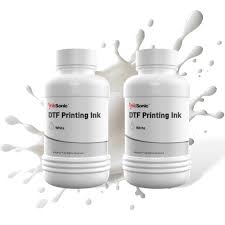
White ink is the most technically demanding component in a DTF printing setup, and it is the one that most operators underestimate until they start seeing problems. Color ink issues are usually visible immediately — a banding artifact, a color shift, a streak across a print. White ink problems often do not reveal themselves until after pressing, or worse, after washing. By then, a customer has already received a print that is cracking, peeling, or looking washed out after three cycles in the laundry.
This review covers what makes DTF white ink perform well, what properties separate reliable formulations from budget options, and how to evaluate suppliers when making a purchasing decision in 2026.
Why White Ink Is Different From CMYK
In DTF printing, CMYK inks produce the design. White ink makes the design visible. On any fabric that is not white or very light, the white underbase layer is what prevents the fabric color from bleeding through and dulling the design. A properly applied, fully opaque white layer allows cyan, magenta, yellow, and black to reproduce colors accurately. A thin or uneven white layer produces prints that look faded or slightly off-color even when the CMYK inks themselves are high quality.
This creates a dependency that does not exist in most other print technologies: the quality of the color output is directly limited by the quality of the white ink beneath it. You can run the best CMYK inks on the market, but if your white ink has poor opacity or applies unevenly, the finished print will look cheap regardless.
White ink also behaves differently from color inks in storage and circulation. Titanium dioxide — the pigment responsible for white’s opacity — is denser than most pigments and settles out of suspension faster. Bottles of white ink that sit unused will separate, and even ink circulating in a printer’s lines can settle in ways that cause inconsistent application if the system is not properly maintained.
What to Look for When Evaluating White Ink
Opacity and pigment load. The primary function of white ink is to block. Opacity is typically expressed as a percentage and represents how effectively the ink prevents the substrate color from showing through. For dark garments, inks with opacity ratings below 90 percent will produce visible color contamination in the finished print. High-quality white inks typically achieve opacity of 92 to 96 percent or higher.
Adhesion to the powder layer. DTF white ink does not bond directly to the garment — it bonds to the adhesive powder layer, which then bonds to the fabric during pressing. White inks that do not adhere properly to the powder produce prints where the design begins to separate from the transfer during or after pressing, particularly around edges and fine details.
Settling behavior and circulation stability. Shops that run continuous production need white ink that stays in suspension long enough to maintain consistent density through a full print session. Inks that settle aggressively require frequent manual agitation, which interrupts production and introduces variability. Printers with active ink circulation systems manage this better, but the ink formulation itself still matters.
Viscosity consistency. White ink that is too thick clogs print heads. Ink that is too thin produces inconsistent layering because the white layer does not build sufficient opacity in a single pass. Quality white inks are formulated within specific viscosity ranges and maintain those ranges across temperature variations typical of a production environment.
Wash durability. The final test of any white ink is how the print holds up after repeated washing. Industry standard testing typically evaluates prints after 20 and 50 wash cycles. Inks that pass these tests without cracking, peeling, or significant fading are considered production-grade. Budget inks that look acceptable initially often fail these durability benchmarks.
Budget, Mid-Tier, and Premium Inks
The DTF ink market in 2026 falls into three rough tiers based on price and performance characteristics.
Budget inks (under $10 per liter) are generally sourced from overseas manufacturers with limited quality control documentation. They vary significantly from batch to batch, which makes consistent production difficult. Shops that have tried budget white inks frequently report issues with print head clogging, inconsistent opacity, and early wash failure. The apparent cost savings rarely hold when factoring in wasted film, reprints, and print head maintenance.
Mid-tier inks ($12 to $18 per liter) represent the value segment for serious operators. These inks typically come from suppliers with documented quality control processes, consistent batch-to-batch formulation, and compatibility testing across common print head types. For shops running production volume, this is the segment that makes the most sense economically.
Premium inks ($20 per liter and above) include some brand-name options marketed for high-end production environments. These can be worthwhile for shops producing very high-value apparel where any quality variation is unacceptable, but the performance differential over quality mid-tier inks is often marginal and difficult to justify purely on output quality.
DTF Printer USA’s White Ink
DTF Printer USA offers DTF white ink at $12.55 per liter, placing it at the entry point of the mid-tier segment. For shops that want reliable, consistent white ink performance without committing to premium pricing, this is a competitive price point backed by a supplier that also provides the printers and other consumables their customers use daily.
The fact that DTF Printer USA operates across the full supply chain — selling both equipment and consumables — means their ink formulations are tested and validated against the printer configurations they sell. That compatibility testing matters for shops that want to reduce the risk of print head issues caused by using inks that were not designed for their specific hardware.
For common questions about ink compatibility, storage, and usage, their set up service covers the questions most operators encounter when setting up a new DTF workflow.
Making the Decision
For shops currently using budget white ink and experiencing inconsistent results, switching to a quality mid-tier option is almost always the right move. The performance improvement typically pays for the cost difference within the first few print sessions through reduced waste and fewer reprints.
For shops already running mid-tier ink and satisfied with results, the case for upgrading to premium pricing is harder to make unless they are producing apparel for markets where any quality variance is commercially unacceptable.
The white ink decision is not just about cost per liter — it is about what that ink costs per usable print. A cheaper ink that produces two reprints per ten transfers costs more in real terms than a better-priced option that runs cleanly. Evaluating white ink on total production economics rather than purchase price alone is the framework that produces better decisions for growing print operations.