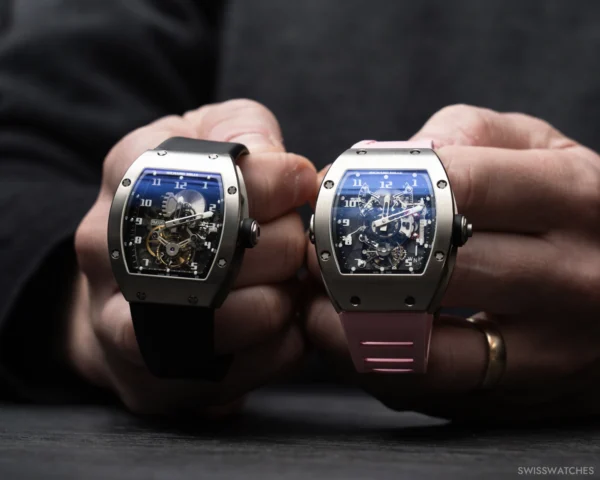
A Richard Mille watch once sold at auction for over $2 million. That was not a one-off anomaly. These pieces regularly trade in the six and seven-figure range, and yet the brand has only existed since 2001. That is an extraordinary trajectory for any luxury manufacturer, let alone one that launched with zero heritage and no historical legacy to lean on.
For a first-time buyer, that context matters. Richard Mille is not a brand you approach casually. The buying process, the pricing logic, the model landscape — all of it requires preparation. This guide walks through what you actually need to know before committing to your first piece.
What Makes Richard Mille Different From Other Luxury Watch Brands
Most traditional watchmakers build their identity around heritage. Patek Philippe’s continuity across generations. Rolex’s association with exploration and precision. Richard Mille flipped that script entirely.
Founded by Richard Mille and Dominique Guenat, the brand borrowed its engineering DNA from Formula 1 and aerospace. The watches are built around materials you would expect to find in a racing car or aircraft, not a Swiss atelier. Think grade 5 titanium, Carbon TPT, and NTPT carbon fiber composites. The cases are lighter than almost anything else in fine watchmaking, yet structurally stronger.
The movement architecture is equally unconventional. Most calibers are skeletonized, meaning the dial is replaced by an open lattice of bridges and baseplate components. Everything visible serves a mechanical function. There is no decorative dial to hide behind.
This is, at its core, a brand built on engineering performance. The luxury positioning comes from the exclusivity of that engineering and the materials cost involved, not from historical prestige.
The Model Landscape: Where to Start
Richard Mille produces watches across several families. Each targets a different use case, aesthetic preference, and, critically, price point.
RM 11 Series
The RM 11 is one of the most recognisable references in the lineup and a sensible starting point for research. It features a flyback chronograph with annual calendar, and the tonneau-shaped case is immediately identifiable as Richard Mille. Pre-owned examples typically start around $80,000–$120,000 depending on materials and condition.
RM 27 and RM 35 Series
These are the models most closely associated with Rafael Nadal’s partnership with the brand. The RM 35 in particular was designed to withstand the physical stress of tennis at the highest level. It is lighter than a sheet of paper on the wrist and among the more accessible entry points in the collection, relatively speaking.
RM 52 Series
For collectors interested in the artistic side, the RM 52 tourbillon range features sculptural dials with hand-finished motifs, skulls, spiders, and other iconography. These are conversation pieces as much as mechanical instruments. Pricing reflects that, usually starting well above $200,000.
RM 67 and RM 72 Series
Thinner, more wearable, and designed with a slightly quieter aesthetic. If you want a Richard Mille that works in a boardroom setting as well as on a yacht, these are worth exploring.
For a broader look at available references, platforms like Wrist Aficionado provide curated inventory across the brand’s major families, which helps you understand what is available in the real market versus what exists only in press releases.
Understanding Richard Mille Pricing
Richard Mille pricing is genuinely unusual compared to other luxury watch brands. A few factors drive this.
First, the materials are legitimately expensive to work with. Carbon TPT, for instance, is a woven composite material that requires specialized manufacturing. The process is not scalable, which caps supply from the outset.
Second, the brand produces in very limited quantities. Annual production figures are rarely disclosed officially, but industry estimates suggest output in the low thousands across all references. Compare that to Rolex, which produces roughly one million pieces per year, and the scarcity dynamic becomes obvious.
Third, resale values have historically been strong, particularly for limited editions and models tied to ambassador partnerships. According to market analysis from platforms like Bob’s Watches and coverage in publications such as Robb Report, certain Richard Mille references have appreciated faster than benchmark investment assets over the past decade.
As a first-time buyer, you should treat retail pricing as a starting reference only. The pre-owned market is where most realistic transactions happen, and prices there are set by supply and demand, not manufacturer guidelines.
What to Look For When Buying Pre-Owned
Buying a pre-owned Richard Mille requires more scrutiny than almost any other watch category. The counterfeiting problem in this segment is significant. The aesthetic of the open case and visible movement is actually easier to replicate superficially than a traditional closed dial, which has made high-quality fakes a persistent issue.
Here is what to prioritise:
- Authentication by a credible specialist. Not a generalist. Richard Mille movements are complex, and authentication requires familiarity with the specific reference. Look for sellers who explicitly certify each piece.
- Box and papers. The original box, warranty card, and documentation are important for both resale value and provenance verification. Missing papers are a yellow flag, not necessarily a deal-breaker, but they should reduce what you pay.
- Service history. These watches are precision instruments. A recent service from an authorised facility adds confidence and practical value.
- Case condition. The exotic materials used in Richard Mille cases can show wear differently than steel or gold. Scratches on Carbon TPT are harder to polish out. Inspect photos carefully or view the piece in person if at all possible.
For buyers in the US, being able to inspect a watch at a physical boutique reduces the psychological risk considerably, especially when you are spending six figures remotely. The team at Richard Mille luxury watches specialists like Wrist Aficionado offer boutique appointments across New York, Miami, and Beverly Hills, which is worth knowing if you want to see a specific reference before committing.
Timing and Market Cycles
Like any asset market, the pre-owned watch market moves in cycles. Richard Mille values peaked alongside broader luxury watch inflation in 2021 and 2022, then softened somewhat as that macro cycle corrected. For buyers, that is actually useful context: the current market is more rational than it was two years ago, and negotiating room exists that did not in 2021.
Patience is a genuine strategy here. If you are targeting a specific reference, tracking it across multiple platforms over 60 to 90 days gives you a clearer sense of fair value before you act.
Key Takeaways
- Richard Mille’s value proposition is rooted in engineering and materials technology, not historical heritage. Understanding that shapes how you evaluate the brand.
- The RM 11, RM 35, and RM 67 families are the most practical starting points for first-time buyers, balancing recognition with relative accessibility.
- Pre-owned is the primary buying route for most references. Retail access is limited by design, and authorized dealers have long waitlists for popular models.
- Authentication is non-negotiable. Counterfeits in this category are sophisticated, and buyer due diligence has to go beyond visual inspection.
- The current market offers more reasonable pricing than the 2021 to 2022 peak. Taking time to track prices before buying is a legitimate tactic.
Frequently Asked Questions
Why are Richard Mille watches so expensive? Several factors combine: genuinely exotic materials that are costly and labor-intensive to work with, very limited production volumes, complex movements designed and manufactured in-house, and a deliberate scarcity strategy. The brand also invests heavily in ambassador partnerships with elite athletes, which adds to overhead and positioning costs.
Is Richard Mille a good investment? Historically, certain references have appreciated significantly. However, treating any watch purely as a financial investment carries risk. The market can and does soften. A better frame is to buy a piece you would be satisfied owning regardless of resale performance, with the understanding that strong demand references tend to hold or grow in value over time.
What is the most affordable Richard Mille to buy? In the pre-owned market, some of the simpler references in the RM 67 or RM 35 family can be found starting in the $70,000 to $90,000 range, depending on condition and provenance. That is the realistic floor for authentic examples in reasonable condition.
How do I know if a Richard Mille is authentic? Get it authenticated by a specialist with documented experience in the brand. Visual inspection alone is not enough. The movement, case markings, engravings, and finishing details all need review. Buying through an established pre-owned dealer who guarantees authentication is the lowest-risk route.
Should I buy Richard Mille with or without box and papers? With, whenever possible. Complete sets command a premium, but they also carry more confidence on resale. If a piece is being sold without box and papers at a price that seems unusually low, treat it with heightened caution.
Final Thoughts
Buying your first Richard Mille is not an impulse decision. It rewards preparation, a willingness to understand the brand’s engineering philosophy, and patience in finding the right piece at a fair price. The market has matured considerably since the brand’s early years, which means better access to information and, in the current cycle, more room to negotiate than buyers had a couple of years ago.
Start by narrowing down which reference family genuinely appeals to you. Spend time with the pre-owned market before committing. And when you are ready to buy, work with someone who can authenticate the piece properly and give you transparency on condition and provenance. That is really what separates a good experience from an expensive mistake.