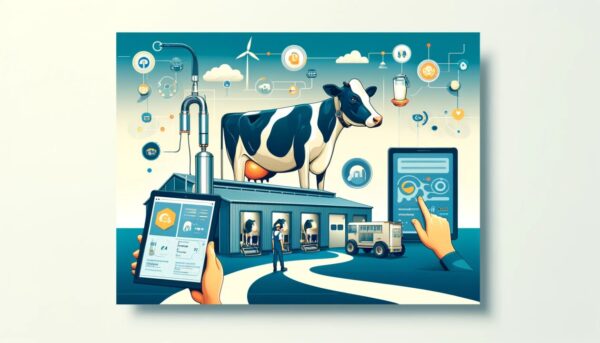
Incorporating automation into the dairy farming industry can bring immense changes to the industry. As more and more farmers demand efficiency, consistency and productivity, farmers are resorting to advanced technologies to simplify their operations. Farm technology in automation of dairy farming is transforming the way routine activities are conducted, eliminating the use of manual labor as well as enhancing farm management. This change is assisting dairy farmers to handle the present-day challenges as well as production standards remain high.
Streamlining Milking Processes
One of the most intensive labor activities in a dairy farm is the milking. Conventional methods are time-consuming and efforts are physical, and involve very rigid timetables and paperwork.
This has been transformed by automation by introducing robotic milking systems. These are systems that enable cattle to be milked in their own convenience and at the same time provide a standard and clean milk increased processes. The automated milking equipment allows less supervision and more efficiency in the process, enabling farmers to work on other significant areas in the farm.
Increasing Animal Surveillance and Wellbeing
Healthy dairy cattle is vital for the production of milk. Health problems that are identified early will avoid bigger problems and losses.
Sensors and monitoring devices which can keep track of the activity of each animal, his or her feeding habits and health conditions are now present in automated systems. Such tools present real time data and this helps farmers identify problems and take necessary steps. Better monitoring results in healthier livestock and the rise of more stable production.
Improving Nutrition and Feeding
Adequate nutrition is very important in the production of dairy farms. Feeding the animals manually may not be enough to ensure the correct proportion of nutrients is given to every animal.
Precision feeding systems have been brought about by automation and provide accurate portions applying to the needs of each cow. Such systems minimize waste and guarantee regular feeding times. Automated equipment enables a better yield in the milk through optimization of nutrition and health of animals.
Reducing Labor Dependency
A frequent dairy industry problem is a shortage of labour and increased prices. Most manual operations need a large man power which may not be easily maintained.
The automated milk farm machinery minimizes the use of human resources because of monotonous and time-consuming work. This does not only reduce the cost of Labor, but also human error is minimized. Also, it allows the farmers to work efficiently with a smaller number of labourers enhancing their production.
Improving Data-driven decision making
The present-day dairy farms produce high volumes of data, both in terms of the output of milk products and the health measurement of animals. This information can be too cumbersome to be handled and analyzed manually.
Automation involves combining data collection and analysis into routine process. Farmers will have access to specific reports and insights that will enable them to make sound decisions. Evidence-based management enhances productivity and detects trends and helps in making better decisions on the growth ahead.
Increasing Operational Efficiency
Automation enables dairy farms to run smoothly by coordinating various processes at a time. Milking and feeding, cleaning and checking, all these actions are taken care of by automated system which is also done in a timely manner.
The associated efficiency of this level minimizes downtime and enhances overall farm efficiency. This enables farmers to be more competitive in the market by having higher productivity and at the same time maintaining the quality of their work.
Supporting Sustainability and Resource Management
The concept of sustainability is gaining more significance in the agricultural sector, and automation plays a part in the more effective use of resources. Automated systems are used to have better control over water, feed and energy consumption.
Dairy farms can minimize the impact on the environment by decreasing their waste and using more efficient resources. This not only augurs well to the environment but also contributes towards the reduction of the costs of operation in the long run.
Improving Animal Welfare
Automation is another factor that improves animal welfare. The arrangement of the cows in systems that enable them to move freely, exercise their free will to milk cows and be taken care of on a regular basis creates a more comfortable environment.
Well-being of the animals is also aided by health monitoring and feeding accurately. Healthy animals are a direct result of better living conditions and this translates to productivity and quality of products.
Conclusion
With greater efficiency coupled with less labor requirements and data-driven management, automation is transforming the operations in the dairy farm equipment. Robotic milking, sophisticated surveillance equipment, and more, these technologies are transforming the way that dairy farms operate. With the ongoing industry transformations, automation will be progressively utilized as a way of assisting farmers on how to grow sustainably, produce and remain competitive in a fast changing agricultural environment.