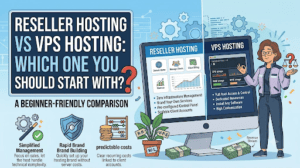
I get asked this question a lot, usually from people who are serious about starting a hosting business but stuck right at the very first decision. Do you go with reseller hosting, where someone else runs the actual server and you just resell space on it, or do you go get your own VPS and build everything yourself from the ground up.
I went back and forth on this exact question when I was starting out, and I ended up trying both at different points, so I want to actually walk you through how I think about it now, instead of just giving you a generic pros and cons list that does not tell you anything useful.
What reseller hosting actually gives you
With reseller hosting, you are basically renting a slice of a server that someone else owns and manages. The hosting company handles the physical hardware, the network, the security patches, all the stuff that happens behind the scenes that most people never think about. You get a control panel, usually something like DirectAdmin or cPanel, and inside that panel you create hosting accounts for your own clients, under your own brand name.
This is the option that gets you moving fastest. You do not need to know anything about server administration to get started. You sign up, you get access to your panel, and within an hour or two you can have your first client account set up and running. I actually went with a reseller plan from Bisup when I first started because their plans begin at $5.99 a month, which meant I could test the whole idea without committing a lot of money upfront.
The tradeoff is that you have less control. You are working within whatever limits the parent hosting company sets, and if their servers have an issue, that affects you too, even though it was never something you had control over in the first place.
What running your own VPS actually involves
A VPS, or virtual private server, is a different setup entirely. Instead of renting a small slice of someone else’s managed server, you are renting a full virtual server that is yours to configure however you want. Nobody else is managing it for you. You are responsible for installing the operating system updates, setting up the control panel if you want one, configuring security, setting up backups, basically everything.
This gives you way more control and way more flexibility. You can run things a reseller plan would never allow, you can customize server settings to fit exactly what your clients need, and you are not sharing resources the same way you would be on a reseller plan sitting on someone else’s shared infrastructure.
But here is the honest part. If you do not already know your way around a server, this is going to be a steep climb. I remember spending an entire weekend the first time I set up a VPS just trying to get email working properly, something that would have taken five minutes on a reseller panel. It is doable, plenty of people learn as they go, but you need to actually want to learn this stuff, not just tolerate it.
There is also the ongoing maintenance side that people forget about once the initial setup is done. Security updates, monitoring disk space, keeping an eye on server load, none of that stops just because you got things working once. On a reseller plan, someone else is watching all of that in the background. On a VPS, that job belongs to you every single day, whether you feel like doing it that week or not.
Reseller hosting vs VPS: comparing the actual cost difference
This is where people usually expect a clear winner, but it genuinely depends on what stage you are at. Reseller plans tend to start lower, since you are only paying for a slice of a server rather than the whole thing. A plan starting around six dollars a month, like what I mentioned with Bisup, gets you a working setup almost immediately.
VPS pricing varies a lot more depending on how much processing power and storage you actually need, but even a basic VPS usually costs more than an entry level reseller plan once you add up what you need to get it properly configured and secured. On top of the actual server cost, you also have to think about your own time, and time spent learning server administration is time you are not spending on getting clients or growing the business, at least in the beginning.
If your budget is genuinely tight and you want to test whether a hosting business is even something you want to run before investing heavily, reseller hosting is going to get you there cheaper and faster almost every time.
There is also a hidden cost people forget, which is the cost of your own mistakes while learning. On a reseller plan, a misconfiguration usually gets caught by the parent company’s setup before it becomes a real problem. On a VPS, a small mistake in a security setting or backup schedule can turn into a genuinely bad day, the kind where a client’s site goes down and you are the only one who can fix it.
Who should actually pick reseller hosting
I usually tell people to go with reseller hosting if they are just starting out and have not run a hosting business before. It removes the technical barrier almost completely, which means you can focus your energy on the actual business side, finding clients, setting fair prices, and giving good support.
It is also the better option if you want to test an idea without a big commitment. You can start small, see if you actually enjoy running this kind of business, and if it is not for you, you have not sunk a huge amount of time or money into infrastructure you now have to figure out what to do with.
Who should actually pick a VPS
A VPS makes more sense once you already have some experience, or once your reseller plan starts feeling limiting. If you have been running a reseller business for a while and you keep hitting resource limits, or your clients need custom configurations that a shared reseller environment just cannot provide, that is usually the sign you have outgrown reseller hosting and it is time to move to something with more control.
It also makes sense if you already have technical experience from another part of your life, maybe you work in tech already, or you have managed servers before in a different context. In that case the learning curve is much smaller and the extra control is worth the extra setup work from day one.
The support side nobody really talks about
Whichever path you pick, you are going to end up doing a lot of support, especially in the early days. Reseller hosting tends to come with a bit of a safety net here, since the parent company handles server level issues and you mostly deal with client account questions. With a VPS, you are the safety net. If something goes wrong at the server level, that is on you to fix, at any hour, whenever it happens.
This is actually one of the reasons I started using agentic ai superbots alongside my hosting business, no matter which setup I was running at the time. It handles a lot of the repetitive support questions automatically, things clients ask over and over like how to reset a password or point to their domain, so I am not stuck answering the same message five times a day. When you are running things mostly on your own, having something to handle the basic stuff for you makes a real difference in how sustainable the whole thing feels.
Reseller hosting or VPS: what I would actually tell someone deciding right now
If I had to give a straight answer, I would say start with reseller hosting if you are new to this, and only move to a VPS once you have a real reason to, not just because it sounds more impressive. There is no extra credit for making things harder on yourself early on. The goal at the start is to get clients, learn what running a hosting business actually feels like day to day, and figure out if this is something you want to keep doing.
Once you have that experience, moving to a VPS becomes a much smaller jump, because you already understand the business side and you are just adding the technical side on top of something that already works. Trying to learn both at the same time, the business and the server management, is usually what burns people out before they even get their first few clients signed up.
A middle ground worth knowing about
Something worth mentioning is that this is not always a permanent choice. Plenty of people start on reseller hosting, build up a solid base of clients, and then move to a VPS later once they actually need the extra control and the business can justify the extra cost and time. You are not locking yourself into one path forever by picking reseller hosting first. Picking the best reseller hosting provider is also a crucial step to maintain your reliability.
I think this is actually the smarter way to approach it for most people. Start where the barrier to entry is lowest, prove to yourself that you can actually run this kind of business, and let your own growth tell you when it is time to move to something bigger. Jumping straight into a VPS because it seems like the more serious option, without actually needing the extra power yet, usually just means more stress and less time spent on the parts of the business that actually bring in clients.
Final thoughts
Both reseller hosting and running your own VPS can absolutely work as the foundation for a real hosting business. Neither one is objectively better, it really comes down to where you are right now, how much time you have to learn the technical side, and how much you want to spend before you even know if this is going to work for you.
If you are still unsure, my honest advice is to start with reseller hosting. It is cheaper, faster to get running, and gives you room to actually learn the business without also trying to learn server administration at the same time. You can always move to a VPS later once you actually have a reason to, and by then you will have a much clearer idea of exactly what you need instead of guessing at it from the very beginning.