Building intelligent robots that can perform complex tasks in real-world environments requires more than powerful AI models and advanced mechanical engineering. The experiences used to train these machines also play a critical role in determining their capabilities. A new Maniformer research study, analyzing more than 200,000 hours of real-robot data, investigates what makes some demonstrations valuable for learning while others can introduce unwanted behaviors.
The study, titled Hidden Variables Behind Real-Robot Data Quality: Lessons from Hundreds of Thousands of Hours, explores the relationship between data collection systems and the performance of robotic models after training.
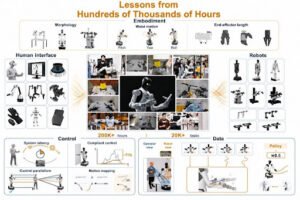
The research brings together more than 200,000 hours of recorded robot activity, over 20,000 task records, structural analysis of 25 dual-arm robots, teleoperation experiments, and real-world post-training evaluations.
Its findings reveal that the usefulness of robotic experience is strongly influenced by decisions made during system design and operation. Factors such as incomplete observations, calibration inconsistencies, inefficient movements, and control delays can affect the information a model receives and ultimately shape its behavior.
Read the Full Study- Hidden Variables Behind Real-Robot Data Quality: Lessons from Hundreds of Thousands of Hours
Why the Quality of Robot Demonstrations Matters More Than Task Completion
A robot successfully finishing an operation does not necessarily mean that its demonstration provides useful information for training.
Consider a robot performing an object-placement task. In one example, it identifies an object, selects the appropriate arm, and places it inside a container through a direct movement. In another, it completes the same operation after several pauses, corrections, and unnecessary adjustments.
Both examples achieve the intended result, but they provide different learning experiences.
The first demonstrates a relatively efficient execution strategy. The second may contain additional movements caused by controller limitations, delayed responses, or operator workarounds.
If an AI model treats every recorded movement as a desirable behavior, it may learn to reproduce these unnecessary actions.
This is particularly important in post-training, where demonstrations directly influence how a specific robot connects environmental observations with physical movements. Unlike general pre-training, which can benefit from broad visual information, real-robot post-training must account for the hardware and operating conditions of the deployed machine.
Maniformer’s research investigates this relationship by examining the complete process behind data generation, rather than focusing only on the final training dataset.
Three Common Data Collection Problems That Can Mislead AI Models
Incomplete Observations Can Weaken Decision-Making
Robots require sufficient information about their surroundings to select appropriate actions. When important visual details are missing from recorded demonstrations, a model may not understand why an operator made a particular decision.
The researchers explored this problem using a block positioned outside the robot’s initial field of view.
The human operator selected an arm based on information available from their own perspective. However, the robot’s recorded observations did not contain enough information to explain that selection.
Models trained on these demonstrations selected the correct arm in approximately 50% of cases, performing no better than random selection.
The collection procedure was subsequently changed so operators shared the robot’s visual perspective and searched for the object before choosing an arm.
With this adjustment, the model achieved 100% accuracy in the reported experiment.
This result demonstrates that useful training data must capture the information behind an action, not simply the action itself. Recording the robot’s observations and decision context can help models develop more reliable relationships between perception and execution.
Calibration Inconsistencies Can Cause Real-World Failures
Calibration determines how a robot translates internal movement instructions into physical actions. If the calibration relationship changes between data collection and deployment, previously learned movements may no longer produce the intended results.
The study found that data collected across different calibration batches could remain useful when the training dataset retained sufficient consistency with the deployed robot.
However, a separate experiment involving a zero-offset calibration error on the deployed robot resulted in the failure of all 30 real-robot trials.
Although the model continued following its learned movement instructions, the robot’s physical response no longer matched the expected coordinate mapping.
This finding highlights why calibration should remain an important part of the entire robotics development process.
Companies need to account for hardware configurations and calibration conditions when collecting demonstrations, preparing training datasets, and deploying updated models. Otherwise, a model that performs well during development may struggle when transferred to physical hardware.
Inefficient Movements Can Become Learned Behaviors
Another problem arises when successful demonstrations contain unnecessary pauses, detours, and corrective actions.
To investigate this issue, the researchers deliberately introduced pauses and additional movements into robot demonstrations. Models trained on the modified data retained approximately 90% of the extra movement patterns.
The impact was also visible in task completion times. As the proportion of demonstrations containing detours increased from 0% to 80%, average completion time increased from 25.3 seconds to 32.6 seconds, approximately 29%.
The underlying issue is that an AI model may interpret an entire successful demonstration as a desirable sequence of actions.
For example, an operator might take an indirect route because the robot’s controller responds slowly. Although this workaround helps complete the task, it does not represent the most efficient execution method.
When such demonstrations are included without proper evaluation, the model may reproduce the same inefficient behavior.
The researchers therefore emphasize the importance of distinguishing between movements required by the task and those introduced by limitations in the robotic system.
Robot Hardware Design Influences the Effectiveness of Training Data
The physical configuration of a robot plays an important role in determining the quality of demonstrations it can produce.
Maniformer’s analysis examined 25 mainstream dual-arm robotic platforms and found that theoretical reach measurements do not always represent practical task capabilities.
A robot might be able to reach a particular position but still struggle to complete an operation because of mechanical restrictions, joint limitations, or insufficient movement flexibility.
Why Physical Reach Does Not Guarantee Task Capability
The researchers examined the relationship between gripper dimensions and the robot’s working space.
Increasing gripper length by 10 centimeters expanded reachable positions by approximately 39.4%. However, this modification also pushed certain joints closer to their mechanical limits.
This illustrates why increasing reach does not automatically improve overall manipulation performance.
The study also examined the influence of waist movement. Allowing the robot to reposition its waist expanded its effective workspace by approximately 3.4 to 5.5 times.
These findings suggest that robotic capabilities should be evaluated through the combined performance of mechanical components rather than individual specifications.
Gripper dimensions, joint flexibility, waist movement, and coordination between different body sections all contribute to practical task coverage.
A well-designed physical platform can also help operators collect smoother demonstrations with fewer unnecessary movements.
Improving Teleoperation Can Produce Better Training Examples
Teleoperation allows human operators to control robots while performing physical tasks. It remains an important method of collecting demonstrations for robotic learning.
However, the design of the control system can significantly influence operator efficiency and the quality of recorded experience.
Traditional arrangements may require operators to switch repeatedly between different robotic components, including the arms, waist, head, and mobile base.
These transitions can introduce interruptions and force operators to complete movements sequentially.
According to the study, switching to parallel control reduced task completion times by approximately 43% to 53%.
This improvement demonstrates how better control coordination can help operators perform tasks more efficiently and reduce unnecessary pauses during demonstration collection.
Compliant Control Reduces Contact Forces
Robots performing physical operations must manage their interactions with surrounding objects and surfaces.
The researchers evaluated compliant control during door-opening and whiteboard-wiping tasks.
The reported results showed that peak contact forces decreased by 71.3% during door opening and 69.1% during whiteboard wiping.
Reducing excessive contact forces can help robotic systems interact more consistently with physical environments.
It may also reduce unnecessary corrections during task execution, contributing to cleaner demonstrations for model training.
Control Delays Can Introduce Unwanted Movement Patterns
Control latency is another factor that can affect the usefulness of robotic demonstrations.
The researchers highlighted that a filtering operation requiring less than one millisecond of computation can still introduce more than 200 milliseconds of phase lag.
This demonstrates that the computational speed of an individual operation does not necessarily reflect the responsiveness of the complete robotic control system.
Excessive delays can cause overshooting, inaccurate positioning, and repeated corrections.
When these behaviors are recorded, they may become part of the training dataset even though they were introduced by technical limitations rather than task requirements.
For robotics developers, evaluating the entire control loop is therefore important. Synchronization, filtering, responsiveness, and physical execution should all be considered when assessing teleoperation quality.
Three Important Questions for Evaluating Robotic Training Data
One of the main conclusions of the Maniformer research is that effective training data should maintain a reliable connection between perception, decision-making, and physical execution.
The study’s findings suggest three questions that developers should consider when evaluating demonstrations.
Does the recorded information explain why the robot performed an action?
A useful demonstration should contain the visual and environmental information required to understand the selected movement. Missing observations can make it difficult for models to learn reliable decision-making behavior.
Will the learned movement remain valid on the deployed robot?
The relationship between internal robot states and physical actions must remain sufficiently consistent. Calibration differences, hardware modifications, and control-system changes can affect the reliability of learned movements.
Does the demonstration represent the task or a technical workaround?
Developers should identify pauses, detours, and corrections introduced by hardware or controller limitations. These behaviors should not automatically be treated as desirable examples simply because the final task was completed.
Together, these questions provide a practical foundation for evaluating the effectiveness of real-robot datasets.
They also highlight why the quality of training data is closely connected to the design and operation of the systems responsible for collecting it.
Companion Studies Investigate Other Methods of Improving Robot Learning
In addition to examining real-robot data quality, Maniformer has explored other research directions involving human visual experience and more detailed robotic task evaluation.
Two companion studies address these areas.
Ego-CEVR Combines Human Videos With Robot-Specific Learning
The Ego-CEVR (arXiv:2610.37509) study explores how first-person human videos can provide useful information for robotic training.
Its approach uses human video to communicate broader task context while relying on robot demonstrations to teach the physical execution of individual actions.
This separation allows models to benefit from relatively inexpensive human visual data without requiring every training example to be collected through direct robot operation.
According to the reported findings, Ego-CEVR achieved an average success rate of 98.1% on the LIBERO benchmark.
In real-robot evaluations, incorporating human video also improved performance across three tasks by approximately 10 to 20 percentage points.
The research suggests that combining human visual experiences with robot-specific demonstrations could provide additional opportunities for expanding robotic training datasets.
ReSTEP and REMORA Improve the Evaluation of Robot Progress
The ReSTEP and REMORA project focuses on understanding how robotic systems behave throughout task execution.
Real-world operations can involve unexpected events, including dropped objects, unsuccessful movements, interruptions, and recovery attempts.
Evaluating only the final result does not provide enough information to understand how a robot reached its outcome.
The project introduces an open-source dataset containing 3,156 real-robot episodes with frame-level error annotations.
It also presents a progress estimation approach designed to monitor task development and recognize events such as failures and subsequent recovery attempts.
In the reported evaluations, the proposed estimator tracked task progress more accurately than the SARM baseline on the tested tasks.
This provides a more detailed approach to understanding robotic behavior and evaluating how systems respond to unexpected situations, as detailed in the ReSTEP and REMORA research paper.
Why High-Quality Experience Will Shape the Future of Robotics
Maniformer’s research highlights an important challenge for organizations developing real-world robotic intelligence: collecting more demonstrations does not automatically produce more capable machines.
The quality of the recorded observations, the consistency of calibration, the physical capabilities of the robot, and the responsiveness of its control system all influence what an AI model learns.
Incomplete visual information can lead to unreliable decisions. Calibration problems can disrupt physical execution. Inefficient control systems can introduce unnecessary movements that become part of learned policies.
Addressing these issues requires a coordinated development approach involving hardware engineering, teleoperation design, calibration management, data collection, and real-world evaluation.
Rather than treating data collection as a separate activity, robotics companies need to consider it an essential part of system development from the beginning.
A continuous learning process can connect these activities. Robots collect experience in physical environments, models learn from the resulting demonstrations, and updated systems return to real-world testing for further validation.
Ultimately, the value of more than 200,000 hours of real-robot experience is not determined by volume alone. Its importance lies in whether the recorded demonstrations teach models the right observations, decisions, and movements needed to perform physical tasks accurately and efficiently.